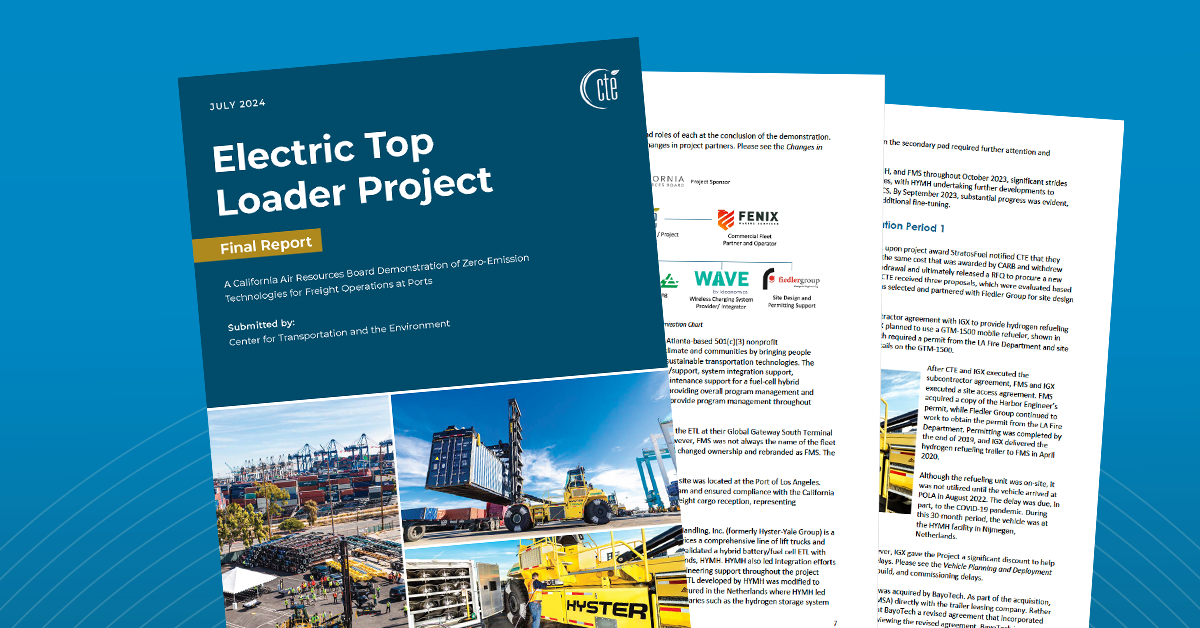
Electric Top Loader Project Final Report
Published: July 2024
Prepared by: The Center for Transportation and the Environment
Overview
The California Air Resources Board (CARB) is charged with protecting the public from the harmful effects of air pollution and developing programs and actions to fight climate change. From requirements for clean cars and fuels to adopting innovative solutions to reduce greenhouse gas (GHG) emissions, California has pioneered a range of effective approaches that have set the standard for effective air and climate programs for the nation, and the world. Assembly Bill 118 (Nùñez, Chapter 750, Statutes of 2007), created the Alternative and Renewable Fuel andVehicle Technology (ARFVT) Program. The statute authorizes CARB to develop and deploy alternative and renewable fuels and advanced transportation technologies to help attain the state’s climate change policies. OnJune 9, 2017, CARB issued an Off-Road Advanced Technology Demonstration Projects solicitation to provide funding for projects, which leverage ARFTVP funds to bring federal cost-sharing projects to California that would provide GHG, criteria pollutant, and toxic air contaminant emission reduction benefits to disadvantaged communities.
In response to this solicitation, the Center for Transportation and the Environment (CTE) partnered with Hyster-Yale Group Inc. (now known as Hyster-Yale Materials Handling, Inc., HYMH), Nuvera Fuel Cells LLC, Fenix Marine Services (FMS), Wireless Advanced Vehicle Electrification (WAVE), and originally StratosFuel, collectively referred to as the “Project Team”, to propose the demonstration of Zero-Emission Technologies for Freight Operations at Ports (Electric Top Loader) Project. The project aimed to extend fuel cell hybrid electric drive transportation technology with wireless-charging to an ETL. This is a market sector where electric drive transportation systems were beginning to be introduced commercially.
To support their portfolio of fuel cell technologies and applications, CARB awarded CTE’s Demonstration of Zero-Emission Technologies for Freight Operations at Ports Project on November 22, 2017. CTE executed the contract with CARB on May 3, 2018.
The purpose of this project was to accelerate the development and deployment of on-board fuel cell hybrid powered Class-8 heavy-duty freight vehicles to substantially increase the zero-emission driving range, thereby reducing petroleum consumption and related emissions, and increasing the viability of these electric drive vehicles. The project also aimed to determine the feasibility of 16-hour freight operation at port facilities by utilizing fuel cell and wireless-charging technology.
Download the Report for Free: