New Guidebook Provides Roadmap for Zero-Emission Freight and Logistics Fleets
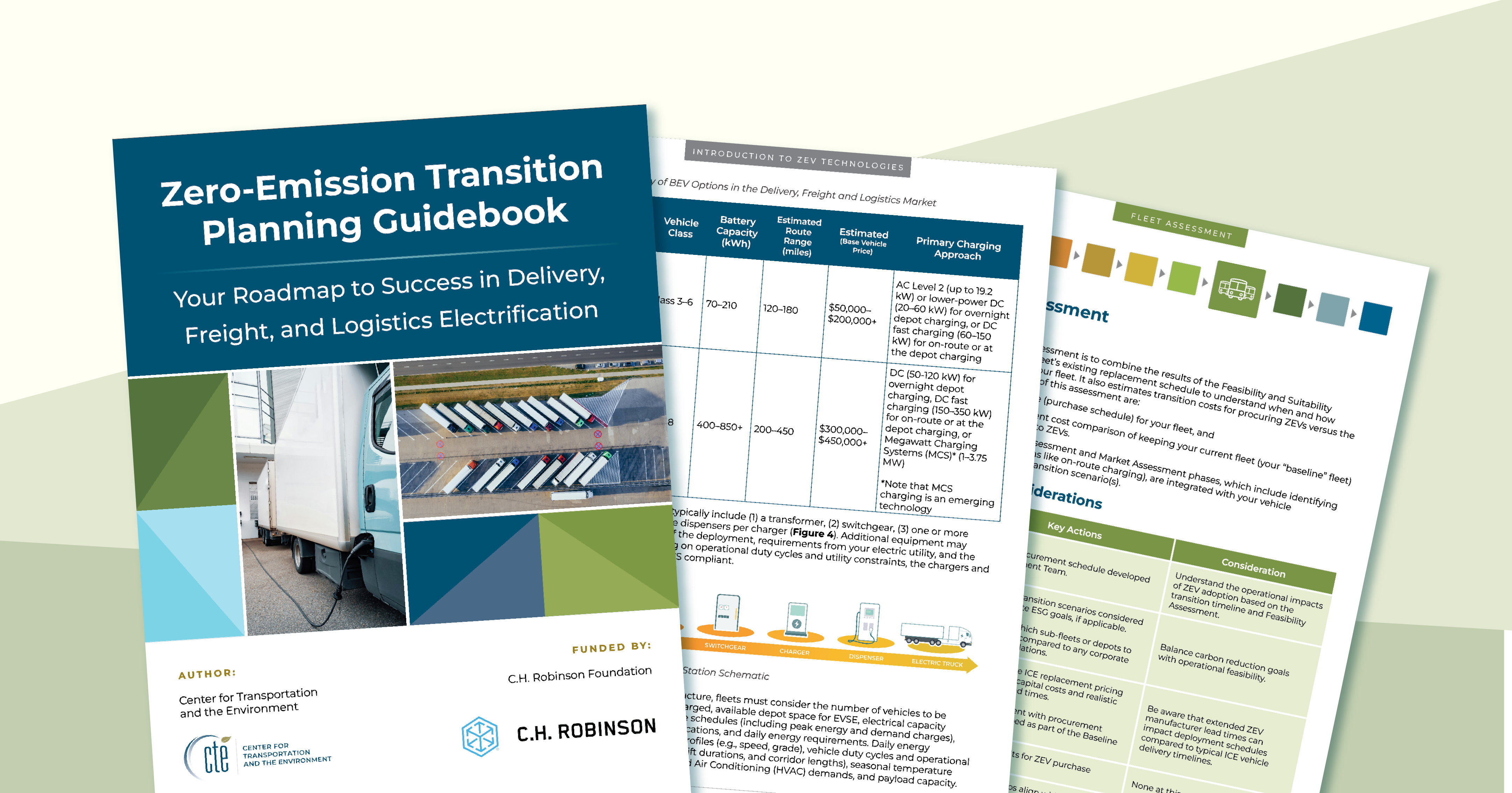
Atlanta, GA – The Center for Transportation and the Environment (CTE), with support from the C.H. Robinson Foundation, has released a new guidebook to help commercial delivery, freight, and logistics fleet operators plan for the transition to zero-emission vehicles. Zero-Emission Transition Planning Guidebook: Your Roadmap to Success in Delivery, Freight, and Logistics Electrification draws on CTE's more than 30 years of experience advancing clean transportation
technologies. The guidebook provides a practical framework for evaluating battery electric and hydrogen fuel cell technologies, anticipating infrastructure needs, assessing financial considerations, and developing realistic, phased fleet transition plans.
As zero-emission vehicle technologies advance, commercial fleets are exploring opportunities to reduce emissions without compromising operational performance or financial viability. However, high upfront costs, range and payload limitations, infrastructure requirements, and workforce readiness present challenges that require careful planning.
CTE's new guidebook addresses these challenges through a structured transition planning methodology that helps fleets make informed decisions about when, where, and how to deploy zero-emission vehicles. Key features include:
- Total Cost of Ownership: Evaluating vehicle and infrastructure costs, long-term operating expenses, and potential break-even points compared to conventional vehicles
- Vehicle Suitability and Performance: Assessing available zero-emission technologies against fleet duty cycles, range requirements, payload capacity, and operational needs
- Charging and Fueling Infrastructure: Identifying infrastructure requirements, evaluating facility readiness, and accounting for utility coordination and installation timelines
- Funding and Financial Planning: Identifying potential funding and incentive opportunities and developing financial strategies to support fleet transition investments
- Workforce Readiness: Planning for the training and operational changes necessary to support new vehicle technologies
- Phased Implementation: Developing a flexible transition strategy that accommodates evolving technologies, funding availability, and fleet requirements
"Transitioning commercial fleets to zero-emission technologies requires more than choosing the right vehicles. Fleet operators must understand how new technologies will affect their operations, infrastructure, workforce, and long-term costs,” said CTE Executive Director Dan Raudebaugh. “This guidebook brings together the lessons we've learned from working with fleets across the country to help operators build practical, achievable transition plans."
The guidebook was developed with funding from the C.H. Robinson Foundation Strategic Industry Grant Program. Since 2005, the C.H. Robinson Foundation has contributed more than $35 million to nonprofit organizations around the world, supporting efforts that create opportunity, strengthen communities and advance the transportation and supply chain industry.
“Moving freight more sustainably has to work in the real world—for fleets, drivers and the customers and communities they serve. CTE brings valuable technical expertise and practical perspective to help the industry navigate those opportunities and challenges,” said Rachel Schwalbach, Vice President ESG at C.H. Robinson and President of the C.H. Robinson Foundation. “Supporting this work is one way we continue to work toward a more resilient supply chain for the industry and the communities that depend on it.”
CTE to Present Guidebook at GTSE 2026
CTE Managing Consultant and Delivery, Freight, and Logistics Market Lead Anna Staddon will introduce the guidebook at the Green Transportation Summit & Expo (GTSE), co-located with RE+ 2026 at the Las Vegas Convention Center. "Zero-Emission Fleet Transition Planning: A Guide for Freight, Delivery, and Logistics Operators" will take place on Monday, November 16, from 9:30 to 10:00 a.m. in Room W210, Level 2, West Hall.
The presentation will highlight the guidebook's transition planning methodology and share practical considerations for evaluating vehicle technologies, understanding total cost of ownership, planning charging and fueling infrastructure, and preparing for successful deployments.
The guidebook is available for free download here.
ABOUT THE CENTER FOR TRANSPORTATION AND THE ENVIRONMENT
The Center for Transportation and the Environment is a 501(c)(3) nonprofit organization with a mission to improve the health of our climate and communities by bringing people together to develop and commercialize clean, efficient, and sustainable transportation technologies. CTE collaborates with federal, state, and local governments, fleets, and vehicle technology manufacturers to complete our mission. If interested in learning more about CTE, please visit cte.tv.
ABOUT C.H. ROBINSON
C.H. Robinson is the global leader in Lean AI supply chains. For more than a century, companies everywhere have looked to us to reimagine how goods move. Now, as we redefine what’s next for the industry, that same drive fuels our commitment to Building Tomorrow’s Supply Chains, Today™. Trusted by 74,000 customers and 450,000 contract carriers, we manage an unmatched 37 million shipments annually, representing $23 billion in freight. We deliver tailored solutions across the world via truckload, less-than-truckload, ocean, air, and more. With our unique combination of human insight and Lean AI working as one, supply chains move faster, smarter, and more sustainably. As a responsible global citizen, we proudly contribute millions to the causes that matter most to our employees. For more information visit www.chrobinson.com. (Nasdaq: CHRW)