Fort Collins Achieves 50% Reduction in Battery Electric Bus Cost per Vehicle Mile
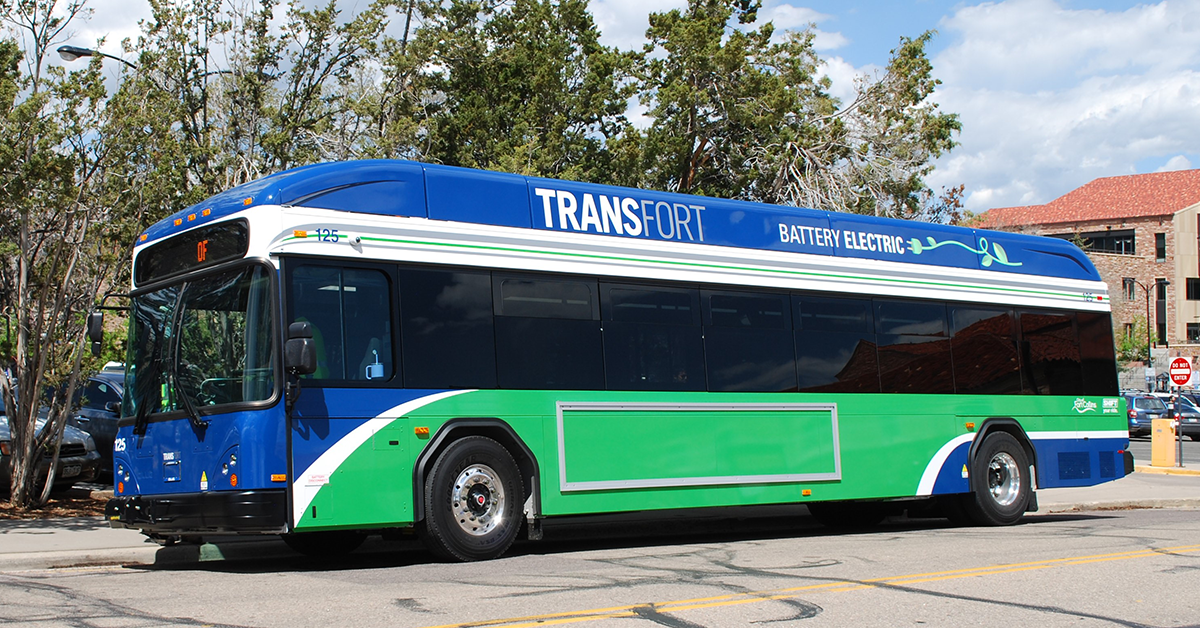
Transfort, the public transportation provider for the City of Fort Collins, Colorado, has reduced fuel and maintenance costs per vehicle mile for its battery electric buses (BEBs) by 50 percent, driven primarily by fuel savings and more effective charge management. The results demonstrate how zero-emission transit can deliver both environmental and economic benefits when paired with careful operational planning.
CTE has supported Transfort throughout its transition to zero-emission buses. Following a successful Federal Transit Administration Low or No Emission Vehicle Program award, the city procured eight new GILLIG BEBs—building on CTE’s earlier Zero-Emission Fleet Transition and Implementation Plan, which modeled routes and charging scenarios to guide Transfort’s long-term fleet strategy.
The first three Low-No battery electric buses (BEBs) were delivered in April 2024, expanding Transfort’s electric fleet from three to six BEBs in revenue service by the end of the year. Following delivery, CTE conducted on-route validation testing to evaluate range, charging efficiency, regenerative braking, HVAC and auxiliary loads, and driver behavior. CTE and Transfort also held a KPI planning workshop to define program goals, reporting needs, and a structured approach to data collection.
Operational improvements, including better charge management and higher BEB utilization, contributed to a drop in cost per mile. Early in the deployment, these BEBs were not running as many miles per charge as they could reliably achieve, but CTE’s performance data gave Transfort the confidence to increase daily mileage and assign BEBs to more demanding routes. This higher utilization significantly boosted per-vehicle mileage, driving cost-per-mile savings that are expected to continue improving as charging strategies are optimized and electricity rates remain stable.
CTE’s analysis has also helped Transfort better understand how external factors, such as temperature and route characteristics, influence performance and operational costs, and where small adjustments can make noticeable improvements. CTE will continue to collect and analyze KPI data through December 2025 to support ongoing operational optimization and provide clear, long-term performance insights.
Together, Fort Collins and CTE are demonstrating that zero-emission transit isn’t just feasible—it can be efficient, practical, and cost-effective when paired with intentional planning and data-driven decision-making.